

If you've seen purple-pink flowers spreading across a field, roadside, or pasture in BC's Interior — there's a good chance you're looking at Spotted Knapweed. It's one of the most aggressive invasive plants in our region, and it's spreading fast.
The earlier you catch it, the easier it is to stop. This guide covers everything you need to know — from identification to treatment — and how to access equipment to tackle it on your property.
Why Spotted Knapweed Is Such a Problem
Spotted Knapweed (Centaurea stoebe) isn't just a weed that takes up space. It actively makes the ground around it hostile to other plants.
It produces a chemical toxin that it releases into the soil, preventing neighbouring plants from germinating and growing. This is called allelopathy — and it's one of the reasons Spotted Knapweed can turn a diverse, productive pasture into a monoculture so quickly.
On top of that:
- A single plant produces up to 140,000 seeds per year
- Seeds remain viable in the soil for up to 8 years
- It spreads rapidly across roadsides, rangelands, pastures, and disturbed areas
- Once established, it significantly reduces forage quality and pasture productivity
- It's largely unpalatable to livestock, meaning animals graze around it — giving it even more space to spread
The Thompson-Nicola region is one of the most heavily affected areas in BC. If you own acreage, a farm, or a rural property in the Kamloops or Merritt area, there's a reasonable chance Spotted Knapweed is either already present or moving toward your property.
How to Identify Spotted Knapweed
Spotted Knapweed is relatively easy to identify once you know what you're looking for — especially when it's in flower from July through September.
Flowers: Pink to purple, with a distinctive fringe of petals around a central disc. Each flower head sits at the end of a branch. The bracts beneath the flower have black-tipped fringes — this is the most reliable identification feature and where the "spotted" name comes from.
Leaves and stem: The stem is erect, branched, and covered in fine hairs giving it a grey-green appearance. Leaves are deeply lobed, alternate, and become smaller and simpler toward the top of the plant.
Height: Typically grows 30cm to 1.5m tall, depending on conditions.
Seeds: Small, brown, with a short pappus (hair-like tuft). Each flower head produces around 25–50 seeds.
Look-alike: Diffuse Knapweed (Centaurea diffusa) is very similar but has white or pale lavender flowers and yellowish, spiky bracts rather than black-tipped ones. Both are invasive — the management approach is the same.
Where it grows: Roadsides, disturbed areas, rangelands, pastures, forest edges, and any area with well-drained, light to coarse-textured soil. It thrives in BC Interior conditions — full sun, dry summers, and the kind of disturbed ground that's common along fence lines, trails, and field edges.
When Does It Spread?
Understanding Spotted Knapweed's life cycle helps you time your management for maximum effect.
Spring (April–May): Plants emerge from the root crown as rosettes. This is an important early treatment window — plants are small and actively growing, making herbicide applications highly effective.
Summer (June–September): Plants bolt and flower. This is peak seed production. Avoid mowing during this period unless you can collect and dispose of all plant material — mowing without disposal spreads seeds.
Fall (September–October): Seeds disperse. Plants begin to die back above ground but the root crown remains alive. Fall is actually one of the most effective herbicide application windows — plants are moving carbohydrates downward into the root system, which carries herbicide deeper.
Winter: Above-ground material dies. Root crown overwinters and re-sprouts the following spring.
How to Control Spotted Knapweed
There's no single treatment that eliminates Spotted Knapweed in one season. Effective management is a multi-year commitment — but consistent effort does work, and the results can be dramatic.
Hand Pulling and Digging (Small Infestations)
For small or isolated patches, hand pulling and digging can be effective — but only if you remove the entire root system. Spotted Knapweed re-sprouts readily from the root crown if it's left in the ground.
- Pull or dig when soil is moist for easier root removal
- Bag all plant material and dispose in designated waste areas — do not compost
- Wear gloves — prolonged skin contact can cause irritation in some people
- Re-inspect the area regularly and remove any re-sprouting plants
This approach works well for isolated plants or very early infestations. For anything larger than a small patch, you'll need a more systematic approach.
Mowing
Mowing can reduce seed production if timed correctly — cut before flowers fully open and before seeds set. However, mowing alone won't control Spotted Knapweed because it re-sprouts from the root crown. It also risks spreading seeds if plants are already in seed when cut.
Mowing is best used as a supplementary tool alongside herbicide treatment, not as a standalone strategy.
Chemical Control (Herbicide)
Herbicide is the most effective control method for established Spotted Knapweed infestations. Several products are registered for use in BC — Purity Feed can help you identify what's currently available and appropriate for your situation.
Two key application windows for maximum effectiveness:
Spring (rosette stage): When plants are small and actively growing in April–May. Herbicide is absorbed efficiently and moves throughout the plant.
Fall: When plants are moving carbohydrates downward into the root system. Fall applications reach the root crown and are often the most effective treatment of the year for perennial invasive plants.
Always read and follow herbicide labels carefully. For larger properties, having properly calibrated spray equipment makes a significant difference in coverage and results.
Equipment Makes a Difference
For larger properties, hand spraying isn't practical. Having access to properly calibrated spray equipment — whether a backpack sprayer, ATV-mounted unit, or tow-behind sprayer — allows you to treat larger areas efficiently and get consistent coverage.
Proper calibration is especially important. Under-application wastes product and leaves plants undertreated. Over-application increases cost and can damage non-target vegetation. Getting it right the first time saves money and gets better results.
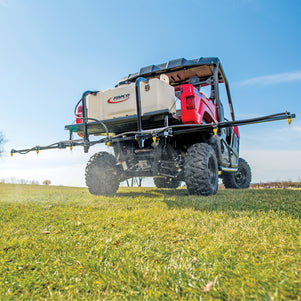
TNRD Equipment Rentals — Available at Purity Feed
📣 Did you know? TNRD Electoral Area residents may have access to free equipment rentals to help manage invasive plants on their property. Visit the link to find out if you qualify.
Book Your RentalTNRD Equipment Rentals — Available at Purity Feed
If you don't own spray equipment or want access to larger capacity units for a bigger treatment area, Purity Feed is your local TNRD equipment rental provider in Kamloops.
📣 Did you know? TNRD Electoral Area residents may have access to free equipment rentals to help manage invasive plants on their property.
Visit the link below to find out if you qualify and to browse available equipment.
A Real-World Result: What Treatment Can Do
One of the most motivating things for landowners dealing with Spotted Knapweed is seeing what consistent treatment actually achieves. A field that's wall-to-wall knapweed in year one can look dramatically different just one or two seasons later with the right approach — native grasses and forage plants recovering as the knapweed population declines.
It takes commitment, but it works.
Preventing Spotted Knapweed From Spreading
If you don't have Spotted Knapweed yet — or you're managing an infestation and want to protect unaffected areas — these habits make a real difference:
Clean your equipment. Seeds attach easily to vehicles, ATV tires, boots, and clothing. Before moving from an infested area to a clean one, brush off all plant material.
Don't move contaminated soil. Seeds survive in soil and can establish wherever that soil is spread. Be cautious about sourcing topsoil, gravel, and fill from unfamiliar sources.
Revegetate bare ground. Spotted Knapweed thrives in disturbed, bare soil. Seeding disturbed areas with competitive native or desirable grasses reduces establishment opportunities. After treating an infestation, overseeding the recovering area helps prevent Knapweed from re-establishing.
Monitor regularly. Walk your property at least once during the growing season with an eye out for unfamiliar plants. Catching a new infestation while it's still a handful of plants is infinitely easier than managing an established population.
Frequently Asked Questions
Is Spotted Knapweed toxic to livestock? Spotted Knapweed is not considered toxic to horses or cattle in the same way that Russian Knapweed is. However, it's largely unpalatable — livestock avoid it — which means it spreads unchecked while other vegetation around it is grazed. This competitive advantage is what allows it to take over pastures so quickly.
Can I compost Spotted Knapweed? No. Seeds can survive composting. Bag all removed plant material and dispose of it in designated waste areas.
How long does it take to control a Spotted Knapweed infestation? Realistically, 3–5 years of consistent treatment is needed to significantly reduce an established population. The first year or two you're knocking back seed production. By years three to five, with consistent follow-up, the population should be noticeably reduced and recovering vegetation starts to outcompete new seedlings.
When is the best time to spray Spotted Knapweed? Spring (April–May, rosette stage) and fall (September–October) are the two most effective windows. Spring targets actively growing plants before they flower. Fall applications reach the root system as plants move energy downward for winter.
Is there a cost-share or assistance program for invasive plant management in BC? Yes. The TNRD offers several programs for eligible landowners, including cost-share options and the equipment rental program available through Purity Feed. Contact the TNRD or stop by our store to find out what's available in your area.
Take Action This Season
Spotted Knapweed doesn't go away on its own — but it can be managed. The most important step is the first one: knowing what you're looking at and deciding to act before it spreads further.
If you're not sure whether what you're seeing is Spotted Knapweed, bring us a photo or stop by in store. Our team is happy to help you identify it and talk through your options.
📣 TNRD Electoral Area residents may have access to free equipment rentals to help manage invasive plants on their property.
Browse Equipment Rentals & Book Online →
Purity Feed | Serving BC's Interior since 1947 | Kamloops & Merritt